Showing posts with label numbers. Show all posts

Tuesday, 10 February 2015

Pete the Cat and his Four Groovy Buttons

Pete the Cat was a huge hit with the kids last time round. The books are fantastic for group reading and involving the kids with their repetitive chants. This one was no different.


Pete loses his buttons but he never loses his cool.

Topic: numbers and colours.

Age: 3- 7 all enjoyed it.

Vocabulary: numbers 4,3,2,1 and 0, I like to do numbers 5-10 as well. Colours yellow, green, red, dark blue and light blue all easy to include too. Also skateboard, icecream, surfing and belly button. Phrases 'My buttons, my buttons, my _ groovy buttons!' and 'goodness no!'

Procedure:

  • sing your hello song. I enjoyed reviewing the emotions for this book. Sad, happy, scared, sleepy.. so we sang it in different ways.
  • Practice counting. I have a points chart so I used that. We counted up and then counted down. Then we counted on our fingers and sang this song: 1 little 2 little 3 little fingers, 4 little 5 little 6 little fingers, 7 little, 8 little 9 little fingers, 10 little fingers on my hands.
  • Now get cracking on the book. Open it up and admire the inside of the front cover. Elict the colours and count the buttons. With the older kids you can even get them to do a little maths 'How many yellow and red buttons are there?'
  • The book is so perfect you don't need me to tell you how to tell it. It is instinctive. THIS VIDEO will help you too. I get the students to clap along with the rap to get them involved. I also like to stop the rap abruptly in a different place each time by saying POP! OH NO! and slapping my forehead. They love that.
  • Table time now: elicit the colours that Pete was wearing and ask them to colour him from memory.
    Here
    • Now bring them back to the circle. Pratice counting again. Hop 3 times. Spin 2...
    • Watch the SCOPE video linked previously and get them to join in, or watch this video with Pete the Cat where he does the wheels on the bus (a song I already did with my students).


    Extensions:

    Any kind of counting video.


    We love Super Simple Songs.

     The kids all want to know if this is my boyfriend. SIGH.
    Colour by numbers HERE
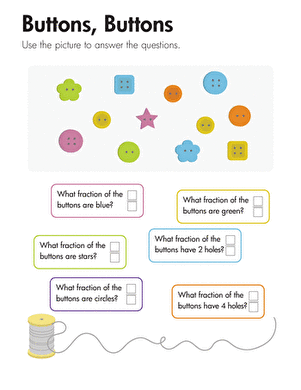
     Plus you can make many button maths worksheets like these.

    See the source image
    HERE

Thursday, 25 September 2014

Walking in the Jungle

So this story book is rather babyish. So babyish in fact that it features a big baby as it's main protagonist. However I've got some students in my class who aren't yet 3... so I think it's pretty much spot on for my target audience.


The pages are a little small in my copy but very clear illustrations

Topic: Jungle animals.

Age: 3-6 (I say six, but there's a reason I'm using this at the beginning of the academic year).

Vocabulary: Jungle animals (snake, elephant, lion, crocodile, monkey) action verbs (walking, running, climbing, stamping, jumping - the book uses slightly different ones, but no 3 year old can read) phrases "Walking through the jungle, what can you see? Can you hear a noise? What could it be?"


Procedure:

  • Sing your hello song. I'm doing mine happily and sadly as these flashcards are crucial to my classroom management routine.
  • The simplified version of If you're happy and you know it (If you're happy happy happy) is a good way to add some of these verbs pre lesson and get them moving.
  • Drill the flashcards with the animal actions.
  • Tell the story encouraging them to say it with you for the older ones and do the actions for the little ones (for jumping/stamping etc make jumping motion with your hands only - it's best if they stay sitting down at first). I like to say the part for 'running through the jungle very quickly' and 'stamp through the jungle in a giant's voice.
  • At the end of the story ask if the baby is happy or sad. Elicit 'nos' and explain he is 'afraid' (- not 'scared' because the video at the end uses afraid.)
  • Your worksheet of choice. The first lesson I asked them to simply draw the animals they could remember from the story.. I got some hippos, but never mind...
  • Then call them back to the circle for video time. It's a beauty.

For older children you can pre teach the animals toucan, tiger and frog.

Extensions:

Snake or animal colouring sheets.


A counting song with a monkey...


A game of FREEZE
The children pretend to be the animal you say and when you say FREEZE they must freeze. If they move they are eliminated if over the age of 5!


And if I had the time/resources...


No idea where the original page is... sorry creator!


Thursday, 30 January 2014

The Very Hungry Caterpillar

The Very Hungry Caterpillar by Eric Carle is a much loved and much translated book, that your students may even have at home already. Students 4-6 love this book for the final transformation.

The paperback version has nice large images that the children at the back can see well and the holes in the pages just add to the magic.
Available on Amazon
Topic: The lifecycle of a butterfly (oh no, I didn't spoil the ending for you did I? You knew he turns into a butterfly, right?)

Age: 4-7years (There's a lot of good recyclable vocabulary here, so you could make it work for older students too)

Vocabulary: Fruit (apple, pears, plums, strawberries, oranges, watermelon). Older kids could also learn or review food items, sausage, salami, cake, cheese, lollypop, pickle, ice cream and pie. Numbers 1-5. Days of the week. Lifecycle stages (egg, caterpillar, cocoon/chrysalis, butterfly). Also sun and moon and the adjectives tiny, small, big, fat and hungry.

Procedure:


  • Sing your hello song hungrily and thirstily, or even more fun, pretend to be very big (slowly and loudly), small and then tiny (fast and squeakily).
  • Preteach the flashcards of the fruit or food depending on what your students know already. For the 4 year olds the five main fruits is really the maximum you can hope for them to learn at a time.
  • Get the students settled and listening. Let them know how you will indicate when you need their help. You can tell the story using the words in the book as they are already very simple. Add gestures for hungry, tiny, big fat, stomach ache and much better. As you say the days of the week, see if they know them in L1. It's cross curricular and the chances are they will be learning them currently. I like to get the children to count out the fruit with me and tell me the colour and the name of it to get them as involved as possible.
  • When the caterpillar makes a cocoon/chrysalis, it might be a good idea to use some L1, as many of the students will be convinced it is a poo! I also ask them how long they think the caterpillar stayed in there for in L1, to get them thinking and build up the suspense for the inevitable transformation.
  • As a final activity I get them to tell me all the colours they can see in the butterfly's wings. 
  • Then they can do this beautiful colouring sheet. From memory they have to colour all the fruits the right colour (warning this takes a long time to finish)!

Available on Eric Carle's website.

Extensions:
  • Tell the story again, pre-teaching and then eliciting the life cycle stages. Ask volunteers to reorder the flashcards for you and then put them in the right order. There are many worksheets out there:


There are many worksheets out there...


  • This video is a nice way to review that language (probably stop at 2.45mins)

  • Butterfly colouring sheets are out there in abundance, or they can draw their own. Don't forget the old classroom favourite of painting half a butterfly on one half of an A4 piece of paper, folding it shut and then peeling it open again. Remember to use poster paints (or acrylics but they don't wash out) not tray paints. 
  • This lullaby is a good settler for the end of the lesson.
  • The days of the week chant to the Adams Family. Days of the week *clap clap* days of the week *clap clap* days of the week, days of the week, days of the week *clap clap* There's Sunday and Monday, Tuesday and Wednesday, Thursday and Friday and then there is Saturday. Days of the week *clap clap* days of the week *clap clap* days of the week, days of the week, days of the week *clap clap.* The key thing is to remember to start with Sunday or the rhythm doesn't work.
  • This worksheet even has a caterpillar theme!